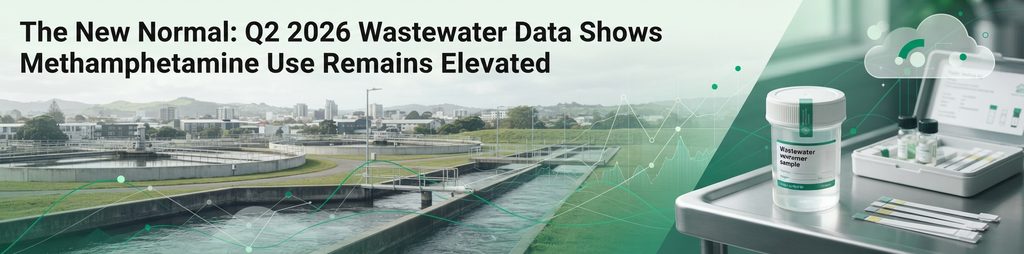
Q1 2026 delivered a sobering message: methamphetamine consumption had not returned to earlier levels — it had stabilised at a record high. The Q2 2026 results confirm that this elevated state is now the new normal.
According to the latest New Zealand Drugs in Wastewater Programme data, methamphetamine consumption averaged 33.3 kilograms per week during April–June 2026. While this represents a decrease from the Q1 average of 36.6 kg, it remains consistent with the average quantity consumed over the previous four quarters. April recorded an exceptionally high 37.0 kg, with levels easing to 32.5 kg by June. The estimated weekly social harm cost stood at $34.9 million.
A Slight Dip, But No Return to Earlier Levels
The data shows that most Police Districts recorded below-average use compared with their own recent four-quarter averages. Northland remained the highest at 1,779 mg/day per 1,000 people, followed by Eastern (1,565) and Waikato (1,485). Tāmaki Makaurau, while lower on a per-capita basis, continues to carry significant total volume due to population size.
This pattern suggests the sharp rise seen through 2025 and into early 2026 has eased, but consumption has not fallen back to pre-2025 levels. The “new floor” identified in Q1 appears to be holding.
The Campaign Arrives at the Right Time
The launch of the Government’s F. Meth prevention campaign on 17 September 2026 is therefore timely. It is encouraging to see growing recognition that methamphetamine is a serious and widespread issue — even if many New Zealanders still do not yet fully appreciate the scale. A visible national demand-reduction effort that speaks directly to individuals and whānau is a necessary step.
However, the regulatory disconnect remains. The Residential Tenancies (Managing Methamphetamine Contamination) Regulations 2026 continue to set the minimum compliance threshold at 15 µg/100 cm² – a level significantly higher than reference points used in Australia and the United States. This threshold was formalised without the further research recommended in the 2018 Gluckman report. As long as this gap exists, the regulatory framework will continue to be at odds with international precedent and uncertainty will follow.
Implications for Property Owners
Q2 2026 reinforces the core message from our Q1 analysis: methamphetamine use is occurring at sustained high levels inside residential properties, the majority of which are rentals. Residue can persist long after users leave, and the absence of visible signs does not mean the absence of risk.
The slight easing in Q2 does not change the underlying exposure environment. It simply means the risk is now “stable at a higher level” rather than continuing to climb. For property owners, this is not a signal to relax vigilance — it is confirmation that proactive risk management remains essential.
What This Means Practically
- Methamphetamine consumption continues to be more than double what it was just 2 years ago.
- The F. Meth campaign provides an important new tool for demand reduction – time will tell how effective it will be.
- The regulatory threshold for rental properties still sits well above international benchmarks.
- Testing at key transition points remains the most effective way for owners to deter meth related behaviour and manage exposure.
Wastewater data continues to act as the canary in the coal mine. In Q2 2026, the canary is still signalling elevated risk.
Data sourced from: New Zealand Drugs in Wastewater Programme — Quarter Two: April–June 2026 (New Zealand Police / PHF Science).
Previous post in this series:
The Record That Should Have Been a Plateau: Q1 2026 Wastewater Data and the Risk Hiding in New Zealand Homes