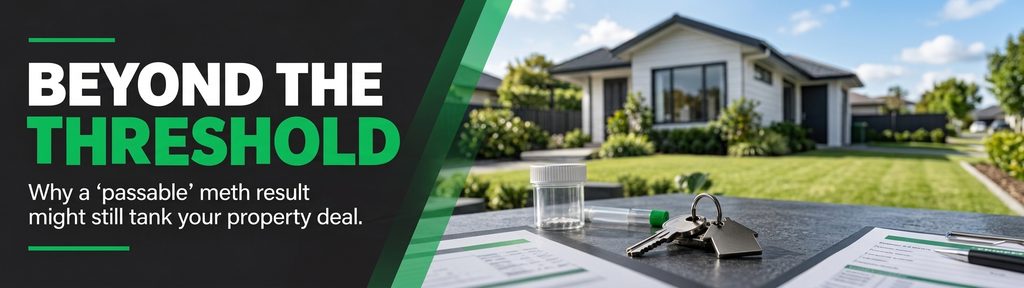
A laboratory report is more than a set of numbers. For property managers, real estate professionals, and landlords, these results represent the line between a successful transaction and a costly mistake. Recently, a client received a pre-purchase report showing a theoretical maximum of 16.4 µg/100cm². While this might seem like a straightforward technicality, it highlights a massive gap between what is legally allowed and what is financially viable.
The Disclosure and Regulation Gap
In this case, the likelihood of a single sample exceeding the 15 µg/100cm² threshold was low. This specific number is the pivot point for real estate agents, as 15 µg/100 cm² is the level that triggers mandatory disclosure under REA guidelines. Because the buyers intended to use the property as a rental, they initially viewed the risk as manageable.
Under the Residential Tenancies (Managing Methamphetamine Contamination) Regulations 2026, a property can be legally operated as a rental if levels remain below the 15 µg/100 cm² threshold. While rentals may face operational challenges, they are not prohibited from being tenanted at these levels. However, compliance with rental regulations does not equate to a risk-free purchase. The buyers had a finance condition in their offer, which changed the entire dynamic of the deal.
What the Bank Thinks of 15 Micrograms
When the buyers were advised to check with their mortgage broker about acceptable contamination levels, the answer was a wake-up call. The bank did not care about the 15 µg/100 cm² rental regulation. Their acceptable limit was 1.5 µg/100 cm².
This creates a significant hurdle. If a bank views anything over 1.5 µg/100 cm² as an unacceptable risk, they may decline finance regardless of what the Residential Tenancies Act says. While a landlord might be legally permitted to rent the property out at 14 µg/100 cm², they cannot buy the property if the lender refuses to advance funds at that level. Not understanding these differing standards has serious implications for the ability to settle a sale.
The Insurance Complication
Finance and insurance are inextricably linked. You cannot get one without the other, and insurers have their own views on meth residue. Some insurance policies are still triggered by the level found in NZS 8510:2017. If a property has pre-existing contamination that exceeds the NZ Standard, obtaining comprehensive cover can become difficult or impossible. Even if cover is secured, claims may be declined due to pre-existing conditions.
Insurance is another requirement of finance that is made much harder by the presence of pre-existing meth contamination. For a landlord, this is a dangerous position. If you cannot insure the property for meth-related damage because of a pre-existing result, you are assuming the full financial risk. A “pass” under the RTA does not mean your investment is protected.
Knowledge as Protection
The risks arising from meth-related behaviour go well beyond the contamination itself. They extend into the ability to settle a sale, the capacity to borrow money, and the security of insurance coverage. Relying solely on the 15 µg/100 cm² regulatory minimum is not a risk management strategy; it is a gamble.
High-quality testing services, backed by deep industry knowledge and experience, are the only way to protect all parties involved. Whether you are an agent facilitating a sale or a landlord building a portfolio, you need to know what lies beneath the surface before the deal is done.
Does your current risk management policy account for the bank’s threshold, or just the government’s?