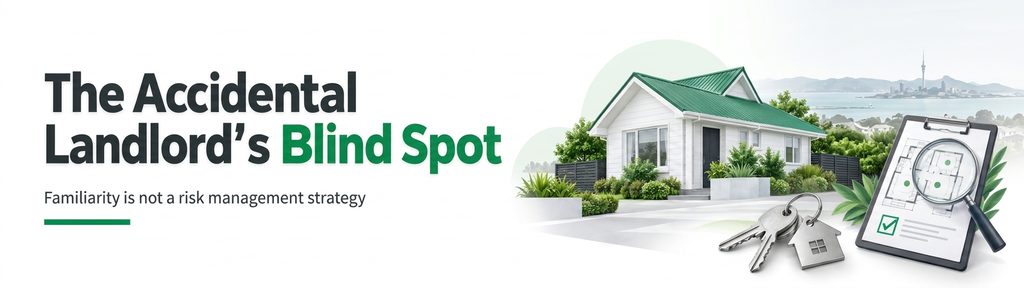
Property sales volumes have softened and for many New Zealanders who need to relocate, selling is no longer straightforward. Renting out the family home has become the practical alternative. The accidental landlord is back.
It is an understandable position. Life circumstances change, and holding a property while moving elsewhere makes financial sense. But stepping into landlord responsibilities without a clear understanding of the risks involved can turn a sensible decision into a costly one.
Methamphetamine contamination is one of those risks. And for the accidental landlord, two assumptions tend to work against them from the outset.
The Government has downplayed the risk
Since the Gluckman report in 2018, government messaging has consistently pointed toward lower risk. The Residential Tenancies (Managing Methamphetamine Contamination) Regulations 2026 set the maximum acceptable level at 15 µg/100 cm², a threshold that sits well above the internationally aligned NZ Standard, NZS 8510:2017, and dramatically above the 0.5 µg/100 cm² investigation level used in Australia.
The practical effect of this regulatory environment is that meth risk is routinely downplayed. When a new landlord hears that only around 4% of tested properties exceed the government threshold, the natural conclusion is that the risk is low. What that figure does not communicate is that approximately 90% of tested properties show some detectable meth residue. Or that meth consumption in New Zealand averaged 33.3 kilograms per week during Q2 2026. Or that consumption has increased by 139% between 2023 and 2026. Or that bank lending still errs on the side of caution and wants individual samples below 1.5 µg/100 cm²
Minimum compliance is not risk management. The regulatory threshold defines what the law requires. It does not define what insurers will accept, what banks will lend against, or what future tenants may claim.
I’ve Lived There for Years It Doesn’t Need Testing
This is the more dangerous assumption, and the one that causes the most harm.
It is entirely reasonable. If you have occupied a property yourself, the idea that it could be contaminated feels remote. But methamphetamine residue does not require a dedicated drug operation to accumulate. Use alone, by a single occupant, is sufficient to leave residue on surfaces. And once a property enters the rental market, the risk profile changes immediately.
The problem is not what happened while the owner lived there. The problem is what happens next, and whether the owner has a documented baseline from which to work.
Without a pre-tenancy test, there is no record of the property’s condition at the point it became a rental. If contamination is identified later, there is no way to establish when it occurred, who was responsible, or what the property’s status was before the tenancy began. That absence of documentation typically removes the ability to pursue accountability through the Tenancy Tribunal and can complicate an insurance claim.
Self-Management and the Advice Gap
Accidental landlords who self-manage, or work with a property manager who has decided that actively managing meth risk is more trouble than it is worth are at particular risk.
Self-managing landlords are less likely to have in place policies and procedures that allow meth risk to be actively managed. Working with a property manager that doesn’t discuss the risks presented to a rental property by tenants who engage in meth related behaviour leaves owners ignorant of a real and growing risk to the family home.
In the absence of a meaningful deterrent, landlords are rolling the dice where meth risk is concerned.
What an Informed Decision Looks Like
The accidental landlord does not need to become an expert in methamphetamine contamination. They do need to understand that:
- Wastewater data confirms meth use is occurring at sustained, elevated levels inside residential properties, the majority of which are rentals.
- A pre-tenancy baseline test is the most straightforward way to document the property’s condition and deter meth-related behaviour.
- The regulatory threshold is a compliance floor, not a safety guarantee.
- Familiarity with a property is not a substitute for verification.
The risk has never been greater. The assumption that it does not apply to your property is precisely the assumption that leaves too many accidental landlords exposed.