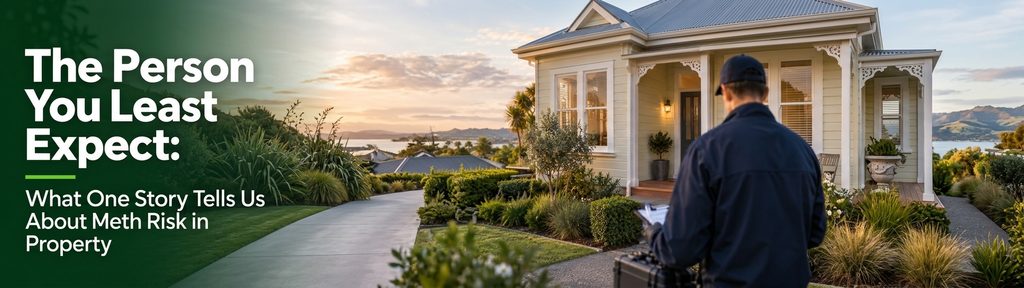
Last week, a New Zealand Teachers Disciplinary Tribunal released its decision on an early childhood teacher who used methamphetamine before work and during lunch breaks while responsible for the care of young children. She was remorseful. She had separated from her partner, relocated, and was seeking support.
She was also, by most measures, the last person anyone would have suspected.
That is precisely the point.
Meth Use Does Not Announce Itself
The teacher’s case is confronting not because it is unusual, but because it is ordinary. She used meth to cope with workplace stress. She functioned. She turned up. She cared about her work. The drug use was invisible to those around her until it wasn’t.
The consequences, however, were not minor. She was responsible for young children during active drug use. The stakes in her professional setting were critical. But the same logic applies in a residential property context. Everyday people using methamphetamine to manage stress, relationship breakdown, or financial pressure can produce outcomes that are far from ordinary. Contaminated homes, compromised air quality, and residue left behind in walls, carpets, and ventilation systems affect the next occupants, who may include children, elderly residents, or people with existing health conditions.
This pattern is consistent with what property professionals encounter regularly. Tenants who use methamphetamine are not a recognisable type. They are parents, workers under pressure, and people managing circumstances that have become unmanageable. Tenant screening and reference checks do not reveal this. Presentation at a property viewing does not reveal it either.
What meth use leaves behind, however, is measurable.
What Our Own Data Is Showing
Wastewater monitoring confirms that methamphetamine consumption in New Zealand averaged 33.3 kilograms per week during Q2 2026, with consumption having increased by 139% between 2023 and 2026. These are population-level signals. The property-level picture is consistent with them.
Screening assessments conducted by Safe and Healthy Home Solutions over the past month, across pre-purchase, tenancy change, and precautionary testing, found 15.5% of properties with results above the NZ Standard, NZS 8510:2017. Over the past three months, that figure rises to 18%. That is 18 in every 100 properties screened on a precautionary basis, with no prior suspicion of an issue, returning results above the standard.
This is not a fringe outcome. It is a structural pattern.
The Compliance Threshold Is Not the Whole Picture
The Residential Tenancies (Managing Methamphetamine Contamination) Regulations 2026 set the maximum acceptable level at 15 µg/100 cm². The NZ Standard, NZS 8510:2017, sits well below that. Australia’s investigation level is 0.5 µg/100 cm². New Zealand remains a global outlier.
Approximately 90% of tested properties show some detectable meth residue. Around 5% exceed the government threshold. But the 18% figure above the NZ Standard represents a meaningful and growing cohort of properties where contamination is present at levels that matter, even if they do not trigger regulatory action.
For property managers, landlords, real estate professionals, and social housing providers, the distinction between “compliant” and “safe” is not academic. It affects insurance outcomes, future tenancy liability, and the health of the people who live in these homes.
The Risk Is Invisible Until It Isn’t
The teacher’s story is a reminder that meth-related harm rarely presents with obvious warning signs. She had since relocated. Her former home, wherever it is, may now be occupied by someone else entirely unaware of its history.
This is the displacement pattern that property professionals need to understand. When tenancies end, the people move on. The residue does not.
Pre-tenancy baseline testing, documented at the point a property changes hands or occupants, is the most straightforward way to establish what condition a property is in and to deter meth-related behaviour from the outset. Without that baseline, there is no reference point. Without a reference point, accountability becomes difficult to establish and liability becomes difficult to manage.
The data from our own screening work, tracking closely with national wastewater figures, suggests the risk is not declining. It is present, it is widespread, and it is being carried by people no one would think to suspect.