We were told the numbers had stabilised. We weren’t told what they had stabilised at.
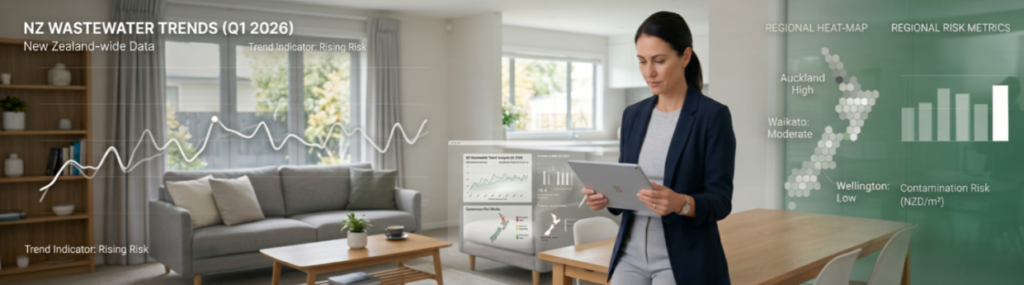
The Q1 2026 wastewater results show methamphetamine consumption averaged 36.6 kilograms per week — 15% above the previous four-quarter average. This is not a return to earlier levels. It is the new floor.
Where this use is happening
Wastewater data cannot identify a specific contaminated property. That remains true.
However, methamphetamine is overwhelmingly used indoors, and the most common setting is a residential rental. When 36.6 kg of methamphetamine is consumed nationally every week, that consumption — and the residue it deposits — is occurring inside homes, including investment properties later sold or re-tenanted.
Meth is not a drug consumed in the open. It is smoked and used in private — in lounges, bedrooms, garages, sleepouts, toilets, and bathrooms. .That residue can persist long after the user has left, and it can transfer to subsequent occupants if it is not identified.
The wastewater programme now covers close to 80% of the New Zealand population. The data it produces is not an abstraction. It reflects real consumption that, in the great majority of cases, occurred inside residential buildings. The most common home where this use takes place is a residential rental — the same type of property many New Zealanders own as part of their retirement planning.
Wastewater data does not tell you that your home is contaminated. It does tell you that elevated use is occurring in the areas where many properties are located, and that this use is most likely happening inside residential rentals.
This distinction matters. The first statement is about certainty. The second is about probability and exposure. Confusing the two — or hiding behind the first to avoid confronting the second — is exactly how risk goes unmanaged until it becomes someone else’s responsibility to address.
$38.4 million a week in harm
The Q1 2026 release estimates a weekly social harm cost of $38.4 million from methamphetamine — a conservative figure that annualises to around $2 billion. This harm is not abstract. It occurs inside buildings. When meth-related behaviour takes place in a property, the residue remains after the user leaves.
The $38.4 million figure is a national statistic. For a property owner, it is also a probability statement about the environment their asset operates in. Deterioration of a community affects the value of the property assets located in it. When meth-related behaviour occurs inside a rental, the financial and reputational risk sits with the owner — whether they are aware of it or not.
Harm that can be reduced if members of society choose to put pressure on meth users. The fact that the $38.4 million figure is described as conservative means actual levels are likely much higher.
What the experts are saying
Professor Chris Wilkins noted that methamphetamine use continues to break records, driven by a sharp fall in price (from $563 per gram in 2017/18 to $334 in 2025) and possible changes in supply. Weekly-or-more-frequent use has risen from 27% in 2018/19 to 57% in 2025.
Associate Professor Fiona Hutton correctly cautions against moral panic. We agree. The issue is not panic — it is whether property owners are managing a risk that the data shows is sustained at record levels. Wastewater cannot tell us the type of use occurring, but it does show the scale and persistence of that use across communities.
The expert commentary accompanying this release is measured. So is ours. We will not overstate what the data can prove about individual properties. We will also not understate what it reveals about the environment in which those properties operate.
The awareness gap
Many properties show no obvious signs of meth-related behaviour. No damage. No complaints. No disclosure. Yet contamination can still be present.
When use “stabilises” at a record high, public attention drops. Stability breeds complacency. The data does not support a complacent approach to asset protection. The absence of visible indicators does not mean the absence of risk. It simply means the risk is harder to see without testing.
In Part 2 of our earlier series we described this awareness gap — the disconnect between perceived risk and actual risk. Q1 2026 widens that gap. When meth use was visibly rising, it generated headlines and vigilance. When it “stabilises” at a record high, the conversation relaxes — even though the underlying exposure environment is at its most intense.
Regional patterns
Most districts recorded above-average methamphetamine use. Northland leads at 2,282 mg/day per 1,000 people — well above its own four-quarter average of 1,818. This is the intensity risk we described earlier: There are fewer properties in these regions, and that translates into higher exposure likelihood per property.
Waikato remains high at 1,685 mg/day per 1,000 despite easing slightly — relevant to anyone operating property through the central North Island. Tāmaki Makaurau carries the scale risk — lower per-capita concentration but the largest total volume, spread across the country’s biggest housing stock.
Canterbury and Wellington show some of the sharpest per-capita increases against their own recent averages — the spread risk converging exactly as we flagged in our earlier articles. The pattern from our previous series holds: risk is not isolated. It is distributed across the system — just expressed differently in each region.
Compliance moved. Behaviour did not.
The 2026 minimum compliance regulations for rental property set:
- 15 µg/100 cm² → maximum acceptable threshold
- 30 µg/100 cm² → uninhabitable threshold
These thresholds define when intervention is required. They do not reduce the behaviour the wastewater data is measuring.
History has shown that relaxing constraints around meth-related behaviour has previously been followed by higher contamination levels found in property. We now have a precise and uncomfortable alignment:
- The compliance line for residential rentals has been formalised and, in practical terms, lifted.
- The behaviour sits at a record, sustained high.
- The exposure pathway — use, deposit, persistence, transfer — is unchanged.
Minimum compliance tells you when you are legally required to act. It does not tell you when you are exposed. Active meth risk management is critical to reducing the likelihood your property ends up on the wrong side of these statistics.
What property owners should do
Q1 2026 reinforces the need for a systematic, evidence-based approach rather than waiting for visible problems.
- Meth use is sustained at record levels inside homes.
- Residue is difficult to detect without testing.
- Regulation sets a minimum compliance line, not a risk-management strategy.
In this environment, testing is no longer reactive. It is a proactive position that allows owners to establish a baseline, deter meth-related behaviour through clear communication with tenants, and make defensible decisions at key transition points.
Not testing is not neutral. It is a decision to operate on assumptions in a year when those assumptions just became more expensive.
Take control of what you can’t see
Wastewater testing remains the canary in the coal mine. In Q1 2026, the canary did not recover.
If meth-related risk is embedded across the property sector — and the national data says it is — your approach needs to be deliberate.
- Book a Baseline Screening Assessment (BSA)
- Test at key transition points – before tenancy starts, during tenancy to mainain focus and before sale/purchase
- Make decisions backed by evidence, not by a compliance line that was never designed to measure your risk and not on the assumptions that meth is no longer a problem.
Do not let “stable at higher levels” be mistaken for “safe.”
Data sourced from the New Zealand Drugs in Wastewater Programme — Quarter One: January–March 2026 (New Zealand Police / PHF Science), with expert commentary via the Science Media Centre and 1News (10 June 2026). Builds on the earlier Safe & Healthy Home Solutions series, Part 1 and Part 2.