Part 2 of 4: This is the second article in our four-part meth awareness series. In Part One: Why a Freshly Painted Ex-Rental Should Raise Questions, we explored why a clean, freshly painted property can still conceal a serious contamination issue. This article examines why the usual “obvious signs” are often absent: and why painting over the problem is not the solution.
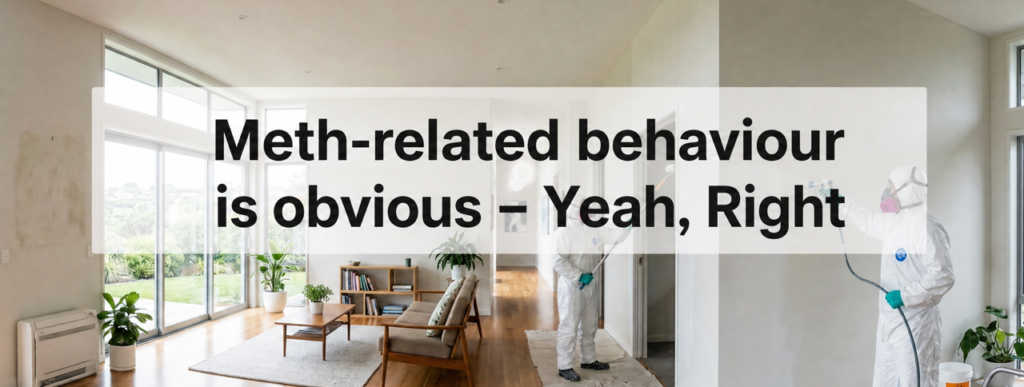
For the government of New Zealand, the signs of meth-related behaviour that mean a property owner must take the reasonably practicable steps to protect the health and wellbeing of tenants are limited to police and council involvement. This criteria for testing occurs in just 1 in 200 properties each year.
Overseas property experts suggest there are often signs that a house has been used for illicit activity. They say these can include a property being unusually trashed or filthy before a sudden renovation, unusual smells like ammonia or vinegar, or even dead vegetation in the yard where chemicals may have been dumped.
Sometimes that is the case. Certainly, signs of damage and rushed renovations are something we recommend you keep an eye on. However, in many cases, the house itself may exhibit none of these signs, particularly if it is located in a nice neighbourhood where such activity is unexpected.
The house looks fine. In those instances, the clues are in the behaviour of the people. More on that another time.
How we respond to adversity makes all the difference
For a decent, hard-working landlord who has and wants nothing to do with meth, the temptation is to jump straight into “fix-it” mode.
The danger of a “quick flip” or a fresh coat of paint is that it can give us the impression the problems are resolved. In reality, they have just become worse: harder to quantify and harder to fix. And that means more expensive.
A fresh coat of paint is not the same as protection
Meth use and manufacture deposits meth residues onto all materials in a house. Most materials in a house act like sponges; they are full of cracks and holes. Meth can stick to the surfaces (adsorb) and move into the paints and building materials (absorb).
The longer the behaviour goes on for and the more meth residues there are in the air, the more they adsorb onto and absorb into these materials. Ordinary painting may improve the appearance of a property, but it is not a contamination management process. Where methamphetamine residue remains on or within affected surfaces, simply painting over those surfaces may hide visible signs, but it does not properly address the underlying problem.
Even without a new coat of paint, meth can be wiped off a surface one day and, over time, the residues can “bleed” or migrate back towards the surface. This also happens with a new coat of paint.
As a result, the meth contamination is “hidden” below the surface and is therefore harder to pick up in sampling. But, because it hasn’t been dealt with, it will continue to emerge through the paint surface.
Why process and professional decontamination contractors are so important
Professional decontamination contractors don’t just wipe surfaces.
Wiping surfaces (the famous, or perhaps infamous, triple wash) is the reason why Kāinga Ora spent tens of millions stripping out property at the same time private landlords were spending far less on non-destructive decontamination. This happened even with experienced professionals undertaking the work.
The new meth regulations for rentals seem likely to lead landlords to believe this DIY approach to meth decontamination will be effective. Time will tell.
What is different about professional decontamination contractors is that they have access to chemicals not freely available to the public. These chemicals penetrate the surfaces they are applied onto and break up the meth molecules within the paint and substrate. They also have years of experience. This experience gives them the confidence to offer fixed-price contracts to get contamination within the reference levels being used. They come back as often as it takes.
The metaphorical ‘icing on the cake’
Bleed-back within painted surfaces and substrates is well documented. The answer is not to put more paint on. It is to finish redecoration with specialised, engineered surface protective coatings. These can be applied to surfaces finished with standard paints, ideally before any problems have occurred or when a new build has been transferred to its new owner.
Unlike standard paint, these coatings do prevent bleed-back. They are also super easy to clean with standard processes and products. Future meth problems do not happen overnight, but they can be resolved quickly and at low cost. The coatings also prevent standard wear and tear and inhibit mould growth. Together, these benefits reduce operational costs and rental downtime.
Join the discussion on LinkedIn: Read the related post and share your perspective