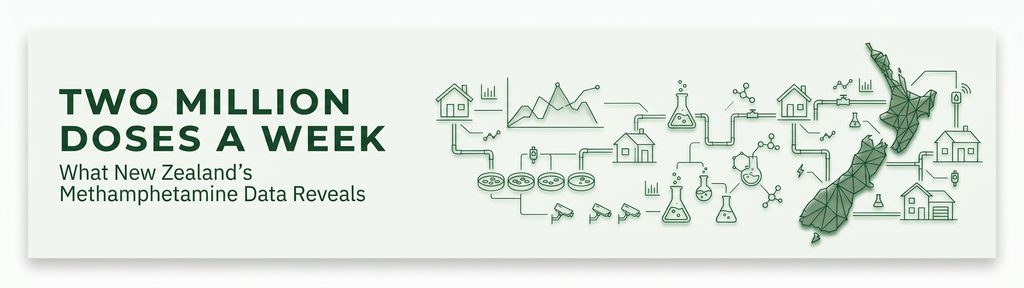
New Zealand’s methamphetamine problem came into sharp focus during the 7 September 2026 edition of Newstalk ZB’s Mike Hosking Breakfast.
Host Mike Hosking highlighted wastewater-testing results showing that around two million doses of methamphetamine were consumed in a single week in April 2026—an increase of approximately 15% on the previous year. That represents an estimated equivalent of roughly 285,000 doses a day.
The scale of the estimate prompted Hosking to question what it represented in practical terms. Was methamphetamine use concentrated among a relatively small number of people using more frequently, or had it become more widespread across communities?
Sarah Helm, Executive Director of the New Zealand Drug Foundation, explained that wastewater testing provides an early indication of changes in drug consumption, although it cannot by itself identify individual users or provide a complete picture of patterns of use. The concern, she said, was that people appeared to be increasing the frequency of their consumption.
That shift is significant. Occasional use becoming more frequent can indicate a growing risk of dependence and more serious harm—not only for the people using methamphetamine, but also for their families, whānau and communities.
Helm also noted that New Zealand’s experience reflects wider international changes in drug supply and consumption. While this statement may be accurate in terms of macro trends around drug supply, it does not acknowledge that the velocity of growth in meth consumption in New Zealand is a complete outlier.
The response: enforcement first, health support now arriving
The Government announced its Action Plan to Combat Methamphetamine Harm in November 2025, led by Justice Minister Paul Goldsmith, alongside Police Minister Mark Mitchell, Mental Health Minister Matt Doocey, and Customs Minister Casey Costello.
The plan combines enforcement measures—targeting organised crime, supply routes, gangs and border activity—with a $30 million health package over four years for addiction and community support.
This was the key distinction Helm made in her discussion with Hosking. While police, Customs and seizure-focused initiatives have been rolling out, the health component is only now reaching communities. In her view, New Zealand has relied heavily on enforcement for decades, and the latest consumption figures show that approach has not fully worked on its own.
Helm was nevertheless cautiously hopeful about the health investment. She referred to a community leader in Kaitaia who was relieved to finally see local help options becoming available. For communities where treatment and recovery support have been difficult to access, that is a meaningful development—but it will take time to establish whether the scale of investment is enough.
The interview raised a difficult question: if enforcement measures and border controls have been in place for years, why is consumption still increasing? The answer points to the limits of relying on supply reduction alone – and to the importance of ensuring that treatment and early-intervention services reach people before more frequent use develops into entrenched addiction.
What was not covered in the discussion was the potential for the policies advocated for by the NZ Drug Foundation and adopted by successive governments, which reduce consequences for drug use to enable drug use. These policy changes include changes to the Misuse of Drugs Act and Residential Tenancies Meth Regulations.
The reality of a meth habit is that the brain chemistry that drives use is typically too powerful for users to overcome themselves. In the absence of powerful external motivators to stop using, habits continue.
How can removal of an imperfect consequence without replacing it with a better one be expected to succeed? Is it a coincidence that demand for meth has increased in the years following the reduction or removal of consequences for meth use?
The New Zealand difference
Wastewater data shows a substantial rise in methamphetamine use in both New Zealand and Australia between 2023 and 2026. In New Zealand, estimated consumption more than doubled, with an increase of 139%. Australia recorded an increase of approximately 23% over the comparable period.
To a point, this supports Helm’s view that methamphetamine is part of a growing global problem. However, the much sharper increase in New Zealand compared with our closest neighbour suggests that local conditions deserve closer examination. The strength of consequences, the point at which intervention is triggered and the time it takes for health and enforcement responses to take effect may all influence how quickly the problem develops. Understanding these factors will be essential if New Zealand is to reverse the current trend.
The wider regulatory tension where property risk is concerned
The Residential Tenancies (Managing Methamphetamine Contamination) Regulations 2026, which came into force on 16 April 2026, apply to the rental sector. The regulations cover that sector of New Zealand property where most of the meth-related behaviour occurs.
The exact proportion of methamphetamine-related behaviour occurring in rental properties is unknown. However, historic New Zealand Police and National Drug Intelligence Bureau data show that 65–75% of detected meth labs were located in rental properties (rising to 75% by 2009). In 2016, 50 of the 74 meth labs identified nationally were in rental properties. Broader government and industry estimates indicate that more than 75% of meth-affected properties are or have been rentals. This supports a reasonable estimate that 60–80% of meth-related activity (manufacture and use) takes place in rental properties.
The regulation provides the specific legal framework for rental properties. It also shapes how methamphetamine-related risk is perceived more broadly.
The current framework is based on the 15 µg/100 cm² threshold recommended by Sir Peter Gluckman in 2018. That recommendation was made alongside a conclusion that further research into methamphetamine contamination and its potential health effects should be undertaken.
However, that research was never completed, leaving the threshold in place without the review that was originally contemplated. So, a science gap was left open. The Regulation also included levels that PHF Science have advised are not supported by science. Under the tenancy regulations:
- An affected room or area is considered contaminated when testing records exceed 15 µg/100 cm², requiring landlords to spend money on decontamination.
- A property is generally considered uninhabitable when testing records exceed 30 µg/100 cm², unless the contamination is confined to a “remote and inconsequential” area.
- The right to terminate only kicks in once levels are >30 µg/100 cm², and tenancies where meth-related behaviour is known to be occurring may not be possible unless sufficient evidence is supplied or the correct process is followed.
For rental properties, the concern is not only the gap between the two thresholds. It is also how high the minimum threshold is in the first place. The level at which the regulations first require action is many times higher than the reference levels applied in comparable jurisdictions, such as Australia and the United States.
In other words, by the time New Zealand’s framework formally recognises contamination requiring remediation, a property could record levels well above those that prompt intervention overseas.
Interventions do not have to be punitive. They can support behaviour change where drug use is concerned. If a housing provider has chosen to provide shelter to people with known meth use habits, evidence of meth-related behaviour can be used to support focused conversations. Done well, these conversations can generate the external stimulus needed to catalyse behaviour change and reduced demand.
Perceptions and reality
The wider concern is that minimum compliance thresholds are used to shape public and professional perceptions of meth-related risk well beyond the tenancy context. A property may test at levels that would be considered significant internationally yet still be treated as legally habitable in New Zealand.
That is a legal/compliance distinction, not evidence that the lower levels are harmless.
This uncertainty would, of course, be completely resolved had the further research the office of the PMCSA concluded was necessary in 2018 been completed.
Not doing the research and ignoring the reported lived experience of some people in favour of a cost-saving perception not only places people at risk but also leads to poor long-term decisions about property management. Decisions on how properties will be managed and maintained are already being made based on the new meth regulations. These decisions will have consequences that are long-term and far-reaching. It is vital that the research the office of the PMCSA concluded was necessary in its 2018 report is completed ASAP.
The challenge ahead
The figures discussed by Mike Hosking and Sarah Helm expose a serious gap between the reality of the scale of methamphetamine use, public perception of the problem and the effectiveness of the current response.
The Government’s health investment is only now reaching communities, so it is too early to assess its impact. However, the wastewater results make clear that the steps which have been taken from an enforcement and policy perspective have not solved the demand problem.
The regulatory framework for residential property, where most meth-related behaviour takes place, raises further concerns. The current approach follows the threshold recommended in 2018, despite calls for further research that was never completed.
Action is not triggered until contamination reaches an extraordinarily high level by international standards. The ability to terminate a tenancy only happens where meth residue levels have reached the level where there is reason to suspect attempts at manufacture.
The current policy framework clearly fails to identify and respond to harm early enough. Behaviour becomes entrenched, and gangs benefit at the expense of people, whānau and communities, the properties they live in and the people who own or have responsibility for them.
Only when people realise that meth use is an issue that directly impacts on their lives and demand better from our politicians, will the pernicious influence of this drug stand a chance of being reduced.
Join the discussion on LinkedIn: Read the related post and share your perspective