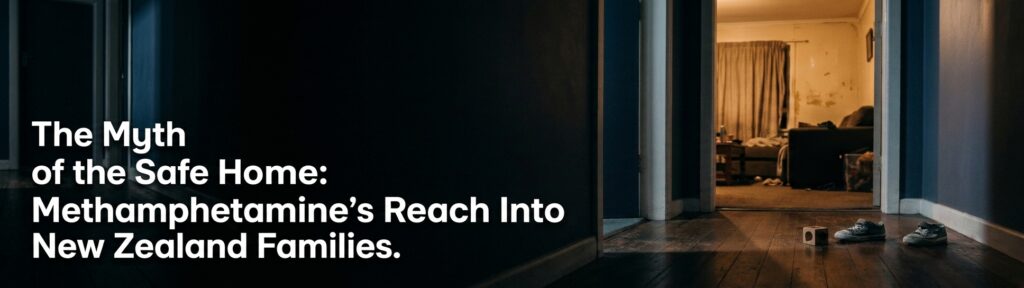
There is a belief that still surfaces whenever methamphetamine is discussed in New Zealand: that meth use is a personal choice, and that if it is used quietly at home, it harms no one else. Therefore, if it is not a problem for the user, why should it be a problem for anyone else?
But “at home” is not an empty space. It is where children crawl, sleep and play. It is where whānau try to keep one another safe. It is where arguments can become fear, where money disappears from household budgets, and where someone struggling with drug use may finally reach the point of asking for help.
In the space of only the past week, multiple news reports have shown the human cost from several different angles: a young child exposed to a devastating mix of drugs; a violent assault in the wake of meth use; grandmothers speaking about fear and financial abuse in their homes; a recovery provider trying not to lose people during the small window when they are ready for treatment; and a major quantity of meth intercepted before it could be distributed into New Zealand communities.
These are not isolated stories. They are individual glimpses of a persistent, nationwide harm.
A Home Should Never Become a Place of Exposure
The most confronting story is from Waikato, where testing found a two-year-old had been exposed to fifteen different drugs, including methamphetamine. The child’s mother was found unresponsive in an Airbnb where drugs and drug-use utensils were reportedly present and accessible. Testing of the child’s hair indicated exposure over a period of months.
It is difficult to read a story like this without asking what “private” use really means when a child is in the room.
Children do not need to understand drugs to be affected by them. They are affected by what is in the air, what is on household surfaces, the adults who are no longer alert to their needs, and the instability that follows when drug use becomes the centre of a home. The harm is not abstract. It is physical, emotional and immediate.
A home is supposed to be a child’s first safe place. When drugs enter that environment, the consequences can reach the people least able to protect themselves.
Meth Does Not Only Change One Person
Methamphetamine is often spoken about as though its effects begin and end with the person taking it. The recent sentencing of a Hamilton man who stabbed another man four times after using methamphetamine and cannabis shows how quickly that assumption can fail.
According to court reporting, the assault followed an allegation that a phone had been stolen. The victim suffered serious injuries, including a punctured lung, and spent several days in hospital. What began as people spending time together became a violent episode fuelled by suspicion, hostility and an erratic state of mind.
No one should claim that every person who uses methamphetamine will become violent. But it is equally irresponsible to pretend that meth-related paranoia, agitation and impaired judgement do not place other people at risk. The people around the user — partners, children, flatmates, neighbours, friends and strangers — can become caught in the consequences of a moment they did not create.
The People Left to Hold Families Together
The damage caused by meth is not confined to the incidents that make it to court. Often, it is carried quietly by the people trying to keep families functioning.
In Hawke’s Bay, members of Nannies Against P have spoken about the toll the meth epidemic has taken on their homes: violence, financial abuse, intimidation and fear. Their experiences challenge the idea that substance use can be neatly contained within an individual’s private life.
When drug use takes hold, grandparents may become unexpected caregivers. Some years ago, Grandparents Raising Grandchildren reported that over 80% of their members were raising grandchildren because of methamphetamine. Since then, meth use rates have more than doubled.
Grandparents may take in grandchildren, cover bills, mediate conflict, manage crises and attempt to keep a sense of normality for young people living in the middle of it. But they also carry grief for the person they love, while also living with the need to protect themselves and others from the harm that person’s drug use can bring.
That is the reality behind the phrase “it does not hurt anyone else.” The harm is often distributed through the whole whānau.
When Someone Is Ready for Help, Time Matters
There is another side to this story: the moment a person reaches the point where they know they want or need their life to change.
In Northland, addiction-support leader Rhonda Zielinski has warned that delays in accessing detox services can mean losing people at the very point they are ready to seek help. Northland has one specialist inpatient detox unit, and demand continues to exceed the support available. Zielinski described the painful reality of having people arrive broken, asking for help, and not always having a place to send them.
That moment of readiness cannot be taken for granted. Recovery is not a straight line, and the decision to ask for help can be fragile. A wait of weeks may sound manageable on paper, but for someone in crisis, it can be the difference between beginning a recovery journey and returning to the same damaging cycle.
If we genuinely want safer homes and safer communities, compassion must mean more than recognising the problem. It must mean having the services ready to respond when people are ready to change.
The Drug That Arrives in Ordinary Places
The recent interception of 3.58 kilograms of methamphetamine concealed in a kitchen stockpot at Auckland International Airport offers another sobering perspective. Customs estimated the shipment represented about 179,000 doses, with the potential to cause millions of dollars in community and economic harm.
A kitchen pot is an ordinary object. That is what makes the image so unsettling. Methamphetamine does not announce itself before it enters a community. It can be hidden in everyday items, passed through ordinary streets, and eventually arrive in ordinary homes.
The fact that one shipment was stopped is important and should be acknowledged. But it is also evidence of the many that are not and should remind us that prevention, treatment, education and support all matter.
Enforcement can interrupt supply; communities also need the tools and services to reduce demand, protect children, support recovery and address harm when it occurs.
The Truth We Cannot Afford to Minimise
The events reported this past week do not represent a sudden, unusual spike in harm. They are a snapshot of something many New Zealand communities experience continuously but most New Zealanders do not see children exposed to unsafe environments, families carrying fear, violence intensified by drug use, and treatment services struggling to meet need.
Methamphetamine does not stay in one person’s system. Its effects can spread through a household, a street, a school, a workplace, a family and a region.
This is not an argument for stigma. Shame rarely helps people recover, and drug use must be met with practical pathways to treatment, dignity and accountability. But empathy must never allow us to turn a blind eye to the harm a person’s drug use can cause to others. We can care about people struggling with methamphetamine dependency and be unequivocal about the danger the drug can create for those around them.
The idea that meth use in a home is harmless because it is hidden behind a closed door is not supported by the reality unfolding in our communities.
Behind that door may be a child. A frightened grandparent. A partner trying to manage someone else’s paranoia. A family waiting for detox support. Or a person who desperately wants to stop but has nowhere to go.
That is why this conversation matters. Not because methamphetamine is a distant social issue, but because it is a deeply personal one — playing out, far too often, in the places where people should feel safest.
Why This Matters to Us?
We have chosen the work we do because we care about people and the communities they live in.
We are measuring meth-related behaviour can reduce the extent of this behaviour that takes place within a home. This in turn reduces the harm one person’s drug use can have on their family, the wider community and the properties we help protect.
We believe it is time the politicians of this country take active steps to reduce demand for drugs, particularly methamphetamine, in this country. We also believe that it is time to widen the conversation regarding ‘harm reduction’ so that it includes all people affected by a person’s drug use, not just the user.
Related reporting
- Waikato mother sentenced after toddler had 15 drugs in his system — NZ Herald
- Man sentenced after attempting to smuggle more than $1 million of meth in kitchen pot — NZ Herald
- Hand around my throat: Hawke’s Bay grandmothers unite against meth — Stuff
- Northland addiction leader warns people seeking detox may miss chance for help — Northern Advocate
- Meth’d-up man sentenced after stabbing associate — NZ Herald