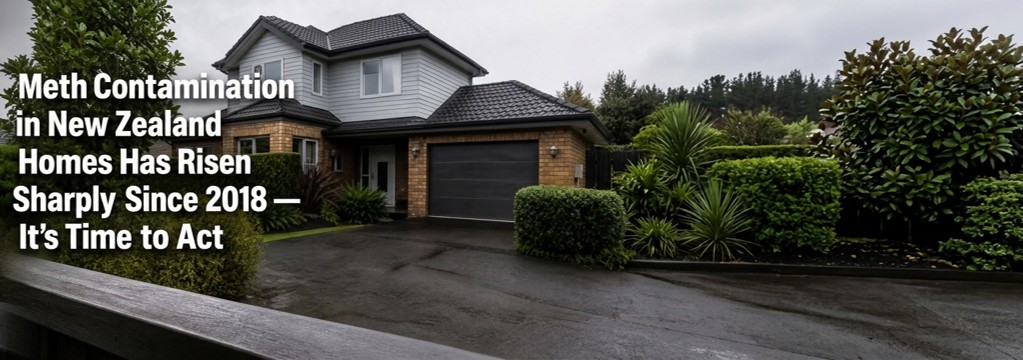
A major new study published in the New Zealand Medical Journal has delivered the clearest evidence yet that methamphetamine contamination levels in tested residential properties have increased significantly since the 2018 government policy change.
The research, led by Dr Muhammad Irfan in conjunction with colleagues at Unitec and collaborators from the University of Waikato, should serve as a wake-up call for all people with an interest in property.
The research confirms the problems associated with meth-affected property are real, measurable, and growing because of government policy.
The 2018 Shift and What Was (and Wasn’t) Done
In May 2018, New Zealand dramatically raised the acceptable methamphetamine contamination threshold from 1.5 μg/100 cm² to 15 μg/100 cm² — a 10-fold increase when compared to the then recently introduced and independently developed standard NZS8510:2017.
The levels in NZS8510:2017 were based on advice provided to the Standards Committee by the Ministry of Health. The recommendations were provided by ESR, which sourced overseas-based scientists to complete the work. This was done as the research had significant political sensitivities in New Zealand.
The May 2018 policy changes followed the recommendations of the Gluckman Report, the 2018 review by the Prime Minister’s Chief Science Advisor. While the Gluckman Report highlighted uncertainties regarding its findings and called for more research, the threshold change recommended by this report was adopted as government policy.
Gluckman’s recommendations regarding acceptable levels have gone on to become the basis for levels included in the Residential Tenancies (Managing Methamphetamine Contamination) Regulations 2026, which were brought into law following recommendations made to Cabinet by the Ministry of Housing and Urban Development (HUD).
These regulations go even further than Gluckman recommended, by including a Maximum Inhabitable level of 30 μg/100 cm². ESR advised HUD that there was insufficient “evidence to define a maximum inhabitable level for methamphetamine”.
In our opinion, it is significant that while most of the recommendations and perspectives included in the Gluckman Report were embraced by the machinery of government, one was not: the recommendation to complete more research.
What happens when more research is done?
New research confirms the problem.
The 2026 New Zealand Medical Journal study examined 1,095 tests across 423 properties tested both before and after the 2018 change. Using a fixed-effects model to control for property-specific factors, the researchers found that the post-2018 period was associated with an average increase of 1.93 μg/100 cm² in contamination levels (95% CI: 0.08–3.77; p=0.040). This represented a 51% increase relative to the pre-policy mean of 3.78 μg/100 cm². Mean contamination rose from 3.78 μg/100 cm² before the change to 7.18 μg/100 cm² afterwards.
Dr Irfan has been clear in subsequent media interviews that rising contamination aligns with increased methamphetamine consumption and use in properties.
Speaking on Newstalk ZB’s Early Edition, he noted the stark difference between New Zealand’s 15 μg/100 cm² threshold and the far lower limits used in Australia, the United States, and the United Kingdom.
The NZ Herald also reported the study’s findings, highlighting concerns about children’s health and the potential for increased healthcare costs.
None of these reports has identified that government policies and regulations have been introduced without completion of the research Gluckman recommended.
Previous Research Already Pointed to the Risks
This is not the first warning. Earlier post-Gluckman research, including work associated with toxicologist Jackie Wright, identified the potential health impacts of methamphetamine residues, particularly for children through hand-to-mouth contact and time spent on floors and surfaces.
ESR’s analysis of this post-Gluckman research identified it as suggestive of a causal relationship, with lower thresholds than those now included in residential rental property regulation.
The new longitudinal study now provides evidence that contamination levels have risen in the very properties being tested under the current relaxed regime. This means more people are exposed to the risk presented by meth-affected property.
RNZ’s coverage of the study included important scientific caution about the strength of evidence on health effects at different exposure levels. But the opinion of experts is that, just like Gluckman before them, more than 8 years ago, more research should be done.
Even without more research, the combination of the new data, prior ESR recommendations, and international comparisons creates a compelling case for revisiting the current threshold.
Why This Matters
The public health stakes are significant. Passive exposure to methamphetamine residues carries risks, especially for children. The study authors note potential links to premature deaths, child maltreatment, and increased healthcare costs. What remains uncertain is the exact threshold at which these health effects manifest – an uncertainty that persists solely because of HUD’s decision not to fund and execute the field research Gluckman called for. With contamination levels rising in tested homes, the question is no longer whether a problem exists — it is whether New Zealand is willing to address it.
It’s time to complete the research Gluckman said should be done
In 2016, when the Ministry of Health controlled the research and narrative where meth-affected property is concerned, the conclusions were focused on the protection of the health and wellbeing of people.
Since 2018, the research and narrative where meth-affected property is concerned has been controlled by the Ministry of Housing and Urban Development. The focus has shifted from the health and wellbeing of people to the costs associated with the provision of housing.
Acceptable contamination levels have now been set in regulations based on theoretical modelling that HUD’s advisors assumed might be tolerable, rather than grounded in empirical evidence demonstrating they are safe. Those levels are 30 to 60 times higher than what is considered acceptable in Australia. They are 10 to 20 times higher than the next highest framework of reference established anywhere else in the world.
The opinions on which HUD relied were qualified; they recommended that more research be done. The research was not done, and a government department, which had the ability to commission that research but has chosen not to, introduced a law which means it avoids direct financial costs.
The latest research by Dr Irfan and colleagues indicates that the number of people exposed to higher levels of meth contamination is on the rise. Other post-Gluckman research by Flinders University, based on the lived experiences of real people rather than scientific theory and opinion, points to the levels chosen by HUD being above those at which some people will experience adverse health responses when spending time or living in meth-affected property.
Decisions are already being made on how to manage meth-affected property using the framework of reference established by HUD’s regulation. Based on post-Gluckman research, these decisions may have profound implications for occupant health and well-being, property owners’ and managers’ operational costs, property values, and risks and liabilities.
We have always contended the levels established at law should be as high as they can be without compromising the health and wellbeing of people who want nothing to do with this country’s meth habit. It is time for the Ministry of Health and Health Minister Simeon Brown to step in and commission a definitive, real-world research programme that resolves the uncertainty regarding this issue.
Join the discussion on LinkedIn: Read the related post and share your perspective