The recent uproar over methamphetamine pipes being sold in discount stores has dominated headlines, but it exposes a more troubling reality: New Zealand acknowledges its meth crisis in rhetoric while maintaining remarkably high thresholds for actual consequences.
When politicians from across the spectrum united in condemning $2 shop meth pipe sales, few noted Green MP Chlöe Swarbrick’s crucial observation: “The sale of these utensils is currently illegal under the Misuse of Drugs Act and has been for years and years.” The pipes weren’t slipping through legislative cracks — they represent an enforcement failure that mirrors a broader pattern in New Zealand’s meth policy that enables meth-related behaviour to thrive.
The Problem Nobody Disputes
The reality of methamphetamine harm in New Zealand is not contested. Where debate remains is the extent of that harm, with the official Drug Harm Index noting that it is a conservative estimate (i.e., on the low side) with little enthusiasm for quantifying what the real level of harm is.
Evidence of the problem, beyond meth pipe sales going unpunished, is widespread.
Wastewater testing consistently shows the problem is “increasing largely out of sight, out of mind in regional New Zealand,” as Swarbrick noted. ESR/PHF data reveal meth use pervading communities from Northland to Southland, with particularly high consumption rates in smaller regional centres where services are scarce. Increased levels of meth-related behaviour are reflected in increased contamination of the property.
The health consequences are devastating: psychosis, cardiovascular damage, dental destruction, and cognitive impairment. The social costs — family violence, child neglect, property crime — ripple through communities. Yet our policy framework treats these harms with surprising permissiveness when it comes to enforcement thresholds.
The 2026 Regulations: A Dramatic Benchmark
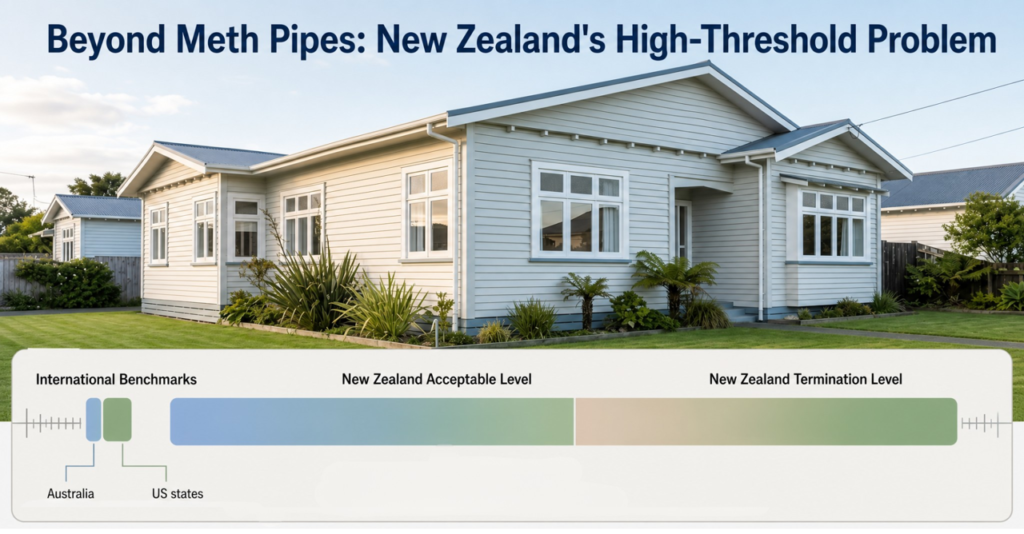
The 2026 Housing (Residential Tenancies) (Managing Methamphetamine Contamination) Regulations, which came into force on 16 April 2026, represent New Zealand’s first formal legislative framework for meth contamination in rental properties. The thresholds established are striking: 15 micrograms per 100 cm² (15 µg/100 cm²) triggers mandatory remediation obligations on the part of landlords, while levels above 30 µg/100 cm² must be reached before the landlord or tenant has the opportunity to terminate the tenancy under this piece of regulation.
These are extraordinary standards by international comparison. Australian states maintain 0.5 µg/100 cm² for residential properties where manufacturing occurred. Most US states with serious meth problems enforce thresholds between 0.5–1.5 µg/100 cm² (Colorado uses 0.5 µg/100 cm², Utah 1.0 µg/100 cm², and California 1.5 µg/100 cm²).
New Zealand’s maximum acceptable level of 15 µg/100 cm² is 30 times higher than Australia’s standard and 10–30 times higher than typical US state requirements. The 30 µg/100 cm² maximum inhabitable level/tenancy termination threshold means tenants can only be removed when contamination reaches levels 60 times higher than Australia’s benchmark.
These regulations were advocated for by the NZ Drug Foundation as far back as 2016. The NZ Drug Foundation lobbied for the political action that led to the publishing of the Gluckman Meth Report. The scientific justification for the thinking that led to this latest piece of regulation. The organisational philosophy of the NZ Drug Foundation where consequences for drug-related behaviour are concerned is that use is a health issue and users should experience no consequence. Consequence is reserved for those who distribute, supply, and manufacture drugs.
The choice of levels that require action under the 2026 Housing (Residential Tenancies) (Managing Methamphetamine Contamination) Regulations aligns with the Drug Foundation’s philosophy.
The maximum acceptable level of 15 µg/100 cm² is linked to use alone. The landlord must clean, but there is no automatic right to terminate the tenancy.
The maximum inhabitable level, 30 µg/100 cm², is the level identified in the Gluckman Meth Report as being linked to manufacture. Only when the level linked by government scientists to manufacture is exceeded can the tenancy be terminated as a matter of right under the new regulation.
The Effect of the Regulations
A property testing at 14 µg/100 cm² — indicating extensive, repeated meth use costing thousands of dollars and inflicting tens of thousands of dollars of harm — requires no remediation, no mandatory tenant notification, triggers no landlord obligations, and is likely to result in limited, if any, consequence for tenants. A tenant producing contamination of 29 µg/100 cm² — levels that would mandate immediate remediation and potential criminal investigation in comparable countries — cannot be automatically evicted under the new regulation in New Zealand. Termination of the tenancy may be possible under other aspects of tenancy law, but it is less certain.
The flip side of this is that tenants moving into property that has been vacated by people who have engaged in meth-related behaviour cannot automatically terminate under this regulation for the same reasons.
The Journey to High Thresholds
This permissive approach to meth-related behaviour stems from New Zealand’s redirection following the 2018 Gluckman report. The internationally aligned New Zealand standard NZS 8510:2017 recommended 1.5 µg/100 cm² as a guideline for high-use areas. Prior to this level being adopted, the guidelines established by the Ministry of Health with a focus on meth labs had been used for all instances of meth contamination. The reference level under these guidelines was 0.5 µg/100 cm². Reporting at the time identified the response to use of Ministry of Health guideline levels as unnecessary panic and exploitation.
The Gluckman Meth Report adopted a narrow definition of what would be considered evidence when considering its position. No engagement with people who had reported adverse health responses while living in meth-contaminated property was undertaken. The report concluded the evidence it admitted was more certain than the view reached by any of the authorities anywhere else in the world that used it to develop guidelines.
The report concluded that third-hand exposure below 15 µg/100 cm² posed minimal health risk — ten times higher than the highest level deemed acceptable elsewhere in the world.
The report also concluded that the lack of published medical evidence the researchers had focused on was not in and of itself evidence there were no health risks unaccounted for by the research. A critical recommendation of the report was that more real-world research be done.
In 2022, draft regulations were developed and circulated for public comment. The draft regulations took Gluckman’s recommended threshold — and made it the regulatory floor for landlord obligations around decontamination. The regulation then doubled this level and set it as the benchmark for the automatic right to terminate a tenancy.
Despite public comment that again highlighted the health response experiences of people being in property where low-level meth contamination was present, well within the thresholds included in the draft regulation, no changes were made.
Finally, in April 2026, the pendulum swung from what was believed to be overly cautious risk-management practice to remarkably permissive legislation.
Not because there was clear evidence it was safe to do so, but because the gap in research, which the government was recommended to fill in 2018, remained unclosed.
The Testing Gap: When High Thresholds Meet Non-Mandatory Requirements
The 2026 regulations do not mandate methamphetamine testing between tenancies; it remains voluntary for landlords and property managers. This creates a challenging environment for property professionals committed to best practice.
Responsible property managers who conduct voluntary testing as part of their duty of care face a regulatory paradox: results showing 8, 10, or even 12 µg/100cm², levels indicating substantial meth use, trigger no legal remediation requirements. These professionals navigate difficult conversations with concerned tenants or buyers about contamination that, while present, falls below the regulatory threshold for action. Despite the complexity this creates, many property managers continue to support client-requested testing as part of informed decision-making and transparency.
However, the high thresholds also provide cover for a minority who take a different approach. Property professionals, including inspectors and testing specialists, report instances where testing is discouraged, even when specifically requested by buyers or tenants, because results below 15 µg/100cm² create additional work without triggering mandatory remediation. No test means no uncomfortable conversations about contamination that’s legally “acceptable” but still concerning to occupants.
This creates an uneven playing field where diligent professionals managing transparency may face more complex client interactions than those who simply avoid testing altogether, with identical legal outcomes. The regulatory structure inadvertently rewards information avoidance while creating additional burdens for those committed to best practice.
What the Numbers Mean
These aren’t abstract figures. Contamination at 10 µg/100 cm² typically indicates regular, repeated meth use over extended periods. At 20 µg/100 cm², international jurisdictions would mandate full remediation including surface cleaning, ventilation system treatment, and verification testing.
At 29 µg/100 cm² — still insufficient for eviction under New Zealand’s meth regulations — comparable countries would likely investigate whether manufacturing occurred, as contamination at those levels rarely results from consumption alone.
Yet a landlord discovering 29 µg/100 cm² contamination cannot terminate the tenancy under meth regulations, and a property owner selling at 14 µg/100 cm² faces no mandatory disclosure obligations.
Enforcement Gaps Across the System
The illegal meth pipe sales illuminate this permissive gap problem perfectly. The law is clear. The harm is undisputed. Yet enforcement remains sporadic until media attention forces action. This pattern repeats across meth policy:
- Precursors: pseudoephedrine restrictions exist, yet online marketplaces advertise suspicious bulk chemical sales.
- Contaminated properties: regulations exist, but thresholds are set so high that most contamination triggers no consequences.
- Testing: property managers often discourage testing to avoid inconvenient findings below regulatory thresholds.
Evidence-Based or Evidence-Avoiding?
The debate between Chlöe Swarbrick and David Seymour touches on legitimate tensions. Swarbrick advocates for harm-minimisation programs like Te Ara Oranga, citing evidence that “we need to improve people’s lives.” Seymour counters that welfare dependency enables chronic drug use.
Both claim evidence-based approaches. Yet New Zealand’s 2026 regulations suggest policy driven more by avoiding liability than addressing harm. While Gluckman’s criticism of panic over trace contamination is understandable, the regulatory response swung to the opposite extreme.
Countries where the response to meth contamination has not been politicised and hijacked by drug-use advocates set thresholds aligned with prioritisation of the risks to the health and wellbeing of non-users. New Zealand has set thresholds so high they effectively decriminalise significant property contamination, discourage voluntary testing, and create a regulatory environment where extensive meth use triggers no consequences.
The Reality Behind the Headlines
As Northland locals urge Whangarei shops to stop selling meth pipes, and Prime Ministers Luxon and Hipkins both express openness to tighter pipe sale regulations, the fundamental irony is stark: we’re debating banning $2 pipes while maintaining contamination thresholds 30–60 times higher than comparable countries.
The problem isn’t that we don’t know meth causes harm. It’s that we’ve set the bar for doing anything about it so remarkably high that the regulatory framework effectively enables the problem it purports to address.
True evidence-based policy would align thresholds with international standards until real-world evidence proved otherwise, mandate disclosure of contamination findings, and support both landlords and tenants in addressing contamination when discovered.
Instead, we have symbolic politics around meth pipes while our 2026 regulations maintain some of the world’s highest contamination thresholds, property managers discourage testing, and the actual epidemic grows largely out of sight.
We acknowledge the crisis in headlines while the regulations whisper: “Not our problem unless it’s really, really bad.”