Recent reporting on rising tenancy terminations and relocations by Kāinga Ora (https://www.waikatotimes.co.nz/nz-news/360921299/kainga-ora-kicked-out-more-disruptive-tenants-2025-previous-four-years) has prompted a familiar public reaction: good — disruptive tenancies are being dealt with.
But there’s a quieter, more practical question property owners should be asking:
Where does that risk go next?
When tenancies end or households are relocated, the underlying issues don’t vanish. People move on — often into private rentals too often owned by well-intentioned ‘mum and dad’ investors — and the next property may inherit uncertainty that isn’t immediately visible.
A housing system with higher churn
The data shows a clear shift in how tenancies are managed in New Zealand. Warning notices are being issued earlier, relocations are more common, and tenancy terminations have increased sharply over the past three years.
From a housing perspective, this means:
- Properties are changing occupants more frequently
- Tenancies are ending earlier in the risk cycle
- Less time passes between one household leaving and another moving in
While this approach may reduce prolonged disruption, it also increases uncertainty around property condition at transition points.
Disruptive behaviour and property uncertainty
Disruptive behaviour can arise from many causes — financial stress, overcrowding, mental health challenges, or lifestyle instability and choices, among others. What matters for landlords is not why a tenancy ended, but what may have occurred inside the property before it did.
Experience across the housing sector shows that challenging tenancies can increase the likelihood of:
- Undetected damage
- Environmental contamination – particularly methamphetamine
- Accelerated deterioration
- Heavy smoke residue
These risks are not always visible during standard inspections.
Why due diligence must go beyond assumptions
When a household leaves under pressure or is relocated, the next landlord or property owner often receives limited information about the full tenancy history. Surface-level checks may suggest a property is acceptable, while underlying risks remain unverified.
This is where active risk management comes in. Risk assessment at the property the tenant has have left is critical and due diligence of incoming tenants are critical.
Responsible risk management is not about assigning blame or making assumptions about tenants. It is about verifying the condition of the property itself and understanding as much as possible about the reasons the tenancy terminates. In this way, decisions are based on evidence rather than guesswork.
Where meth testing fits in
Meth contamination is not the cause of all disruptive tenancies, and it should never be assumed. However, meth use is a contributing factor in many cases of disruptive behaviour. While not specifically referenced in the article, experience across the housing sector indicates that Kāinga Ora properties and tenancies are among those most affected by methamphetamine related behaviour. It is therefore innevitable that some tenancy terminations occur in this context.
Meth testing does not seek to explain behaviour. Rather, it provides objective information about the condition of a property at a point in time. It creates a framewirk of accountability around meth related behaviour. This means regular testing can act as a practical deterrent where expectations around testing are clear.
For this reason, meth testing should form part of a broader tenant-selection and transition due diligence toolkit.
As outlined in our earlier discussion on the upcoming changes to methamphetamine regulation, the implications of contamination are no longer limited to remediation alone. The way contamination is identified, documented, and timed increasingly influences how risk is interpreted after the fact.
Risk is increasingly displaced, not removed
As tenancy enforcement tightens and relocation of disruptive tenants becomes more common, risk is less likely to be contained within one property for long periods. Instead, risk arising from meth related behaviour will be displaced across the housing system.
In this environment, independent screening and clear documentation protect:
- Property owners, by reducing risk exposure and potential liability
- Property managers, by supporting defensible decisions
- Incoming tenants, by ensuring homes are genuinely safe
Evidence over emotion
Rising tenancy terminations do not automatically mean meth contamination of the properties involved. But they do mean more moments where certainty matters.
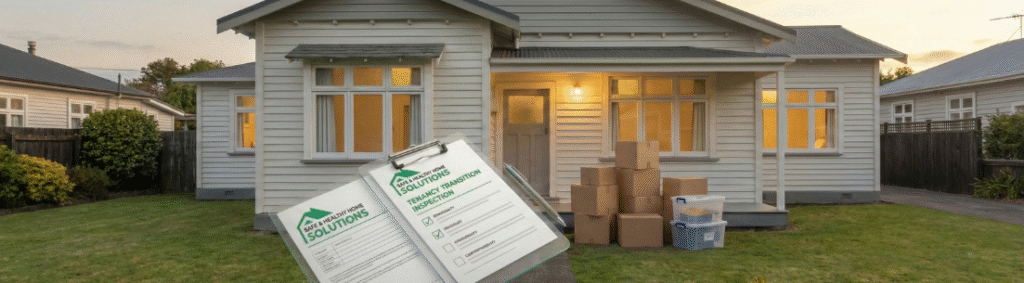
At Safe & Healthy Home Solutions, we support landlords and property professionals with practical screening and evidence-based reporting, helping ensure that property transitions are informed, responsible, and defensible — regardless of how or why a tenancy ended. Doing so means risks associated with meth related behaviour are managed.
Because in a system with higher turnover — and changing regulatory benchmarks — verification of what otherwise is a largely unmanaged risk matters more than ever.