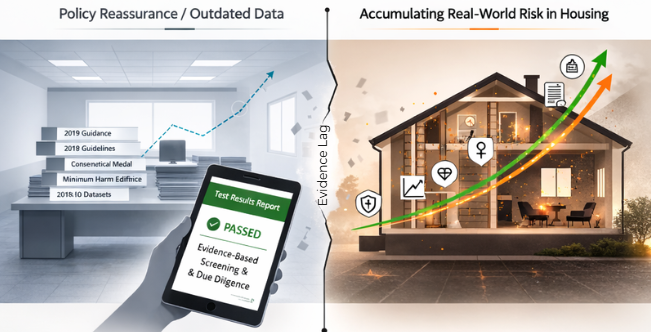
Much of New Zealand’s approach to meth-related harm is shaped by official studies and guidance that, while credible at the time they were produced, are now materially out of date and incomplete.
This is not unusual in public policy. Large national studies take years to compile, validate, and publish. However, when those studies are used as anchors for reassurance, rather than minimum baselines, they can unintentionally mask growing risk — particularly in areas like housing, where consequences emerge slowly but persist for decades.
The New Zealand Illicit Drug Harm Index 2023 (DHI) is a useful example. Not because it understates the harm of meth — but because, even in its conservative form, it demonstrates how significant the problem already is, while simultaneously highlighting how much harm is not being captured.
Conservative data does not mean low risk
The DHI 2023 estimates that illicit drugs cause $1.94 billion in social harm, with methamphetamine responsible for approximately $865 million of that total. These figures are based on 2021 data, yet they continue to be relied upon to inform policy discussions today.
To illustrate how far the official figures are lagging behind current conditions, NZ Police wastewater testing for Q1 2025 estimated weekly social harm from methamphetamine alone at $34.6 million. Annualised, that equates to just under $1.8 billion per year — almost matching the estimated harm for all illicit drugs combined only four years ago.
Even more importantly, the report explicitly states that the estimate is conservative by design, rather than a full measure of total harm.
Crucially, entire categories of harm are excluded, including:
- The long-term impact of parental meth use on children
- Many downstream social and housing-related consequences
- Chronic harm that does not result in hospital admission or coronial involvement
- Unreported crime
In other words, the DHI does not represent the full harm caused by meth — it represents the minimum harm that can be robustly measured.
That distinction matters.
The same pattern exists in meth contamination policy
The way meth contamination risk is treated in housing policy follows a similar pattern.
Much of the current guidance still traces back to Gluckman-era assumptions from 2018, formed when:
- National meth use levels were materially lower
- Wastewater testing was far less developed
- Field testing data was limited
- Long-term exposure pathways were poorly understood
Since then, meth consumption has increased significantly, and industry testing data shows contamination patterns that differ markedly from those seen when the guidance was established.
Yet the policy framing has largely remained static.
This creates a familiar risk dynamic:
- Old data is used to justify present-day reassurance
- Reassurance suppresses short-term costs
- The underlying risk continues to accumulate
- Liability emerges later — in housing stock, health outcomes, and legal exposure
Underestimating harm does not eliminate it — it delays its impact
Downplaying risk does not make it disappear. It simply determines who carries it, and when.
When conservative models are used to support cost-saving policy decisions today, the unmeasured harm does not vanish — it is deferred. In the context of meth contamination, that deferred harm often surfaces as:
- Reduced property value
- Disputes between buyers and sellers
- Landlord liability
- Tenant health concerns
- Insurability challenges
- Long-term social and remediation costs
The uncomfortable reality is that property owners and buyers increasingly carry the residual risk created by evidence lag and policy delay.
Why “absence of evidence” is not evidence of absence
One of the most dangerous assumptions in this space is the idea that:
If risk were serious, policy would already reflect it.
History shows this is rarely true.
Policy typically lags emerging risk, especially where:
- Data is difficult to quantify
- Harm unfolds over long timeframes
- Costs are politically inconvenient
- Liability is diffuse rather than immediate
Meth contamination sits squarely in this category.
The lack of updated national guidance does not mean the risk has diminished. It often means the risk has become harder to see, while growing both in terms of the scale of the problem and the complexity associated with management.
What this means for property owners and investors
This is not an argument for alarmism. It is an argument for informed risk management.
For property owners, landlords, and buyers, the key insights are:
- Official guidance should be treated as a floor, not a ceiling
- Conservative harm models imply greater real-world exposure, not less
- Unknown property history represents unpriced risk
- Risk ignored today often reappears as liability tomorrow
Meth contamination risk should therefore be managed in the same way as any other material property risk — through evidence, documentation, and informed decision-making, not assumptions or reassurance narratives.
Why evidence-based screening matters more as uncertainty grows
National studies explain why meth risk exists.
They do not determine whether it applies to a specific property.
That is where evidence-based screening plays its role.
Screening allows owners and buyers to:
- Replace assumption with fact
- Avoid unnecessary remediation
- Identify genuine risk early
- Demonstrate due diligence
- Make conscious, informed decisions
In an environment where policy lags reality, property-level evidence becomes more important, not less.
Final thought: risk does not wait for policy to catch up
The DHI 2023 does not minimise the harm caused by meth. It unintentionally highlights something more important:
even our best national models are behind the curve.
When harm is underestimated, risk does not disappear — it simply shifts forward in time and outward in responsibility.
For property owners and investors, the choice is straightforward:
Manage meth risk before meth risk manages you.
That is not fear.
That is prudent risk management.
Source: National Drug Intelligence Bureau. The New Zealand Illicit Drug Harm Index 2023: Research report. Ministry of Health, published July 2024.