Key points
Direct Effect
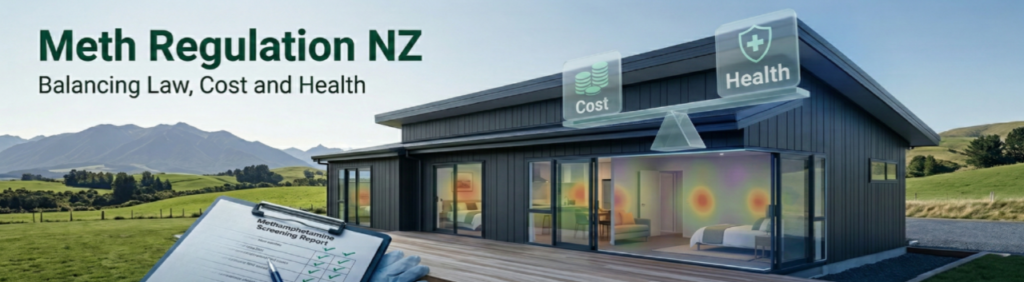
Key outcomes – the regulation introduces changes to NZS8510:2017 that may reduce some of the short-term operational consequences and costs arising from meth-related behaviour.
Landlords can undertake their own screening assessments without a requirement to be trained in how to do so.
Actions under the Residential Tenancy Act will need to be supported by a detailed assessment undertaken by an accredited company.
Thresholds for action are at least x10 higher than the internationally aligned NZ Standard for cleaning requirements. They are at least x20 higher for declaration of a property being uninhabitable, and statements around contamination for the purposes of regulation require a detailed assessment by an accredited company.
Only when thresholds for habitability are exceeded — levels that Gluckman’s Meth Report identified as being indicative of manufacture — will a landlord have certainty they can terminate a tenancy. Ending tenancies where meth-related behaviour is occurring is therefore likely to become harder.
Clean-back levels are at least x10 higher than the internationally aligned NZ Standard. The recommendations for clean-back levels in the Gluckman Meth Report have been dropped.
Carpets can simply be cleaned. We have seen no evidence that this is effective in reducing risk exposure associated with carpets to an acceptable level. The difficulty associated with cleaning carpets in a manner that effectively reduces risk is why NZS8510:2017 recommends carpet removal.
Landlords can self-clean. There is no requirement for landlords to undergo health and safety training, despite landlords being PCBUs and likely to be assisted by others.
Once decontamination is complete, there is no requirement to issue a Certificate of Clearance. This was a quality assurance check included in NZS8510:2017.
So, compliance costs are reduced in the short term, but certainty regarding the effectiveness of decontamination works will also be reduced.
Setting a law at a level that requires x10 more meth to be present before decontamination is required reduces operational costs associated with decontamination, particularly for organisations such as Kāinga Ora.
Additionally, the regulation establishes at law what is and is not acceptable where meth contamination is concerned. Consequently, the potential for landlord liability to increase substantially as a result of the regulation is something owners will need to consider.
When contamination is known to exceed levels requiring clean-up, the landlord must act. Waiting for levels to reach habitability thresholds that allow for termination appears to be ruled out.
Much will therefore depend on how the Tenancy Tribunal chooses to interpret the law.
The flow-on effect
The flow-on effects of a regulation brought into effect after limited engagement with service providers in the meth testing and decontamination sector are foreseeable.
While there is certainty around the numbers that determine whether a property needs to be cleaned or is habitable, formalising those numbers relies on accredited companies. There are very few of these. Government actions that have undermined confidence in NZS8510:2017 mean many responsible and experienced companies offering detailed assessment services have not invested the tens of thousands of dollars needed to complete accreditation. This may create a service supply issue.
Despite how the development of the thresholds for action has been portrayed, they are not based on evidence of a lack of problematic health effects. They have been selected to balance the cost of remediation and security of tenure for tenants — principally people with meth use habits — against health effects on non-meth users.
The evidence of adverse health responses to meth contamination that does exist was deemed insufficient to stop the regulation. No real-world research was undertaken, despite the lived experience of many people being that they respond adversely when entering a property later found to be contaminated.
That lived reality means that for many people a technically “compliant” property will present an unacceptable risk, reducing its desirability.
Levels of contamination that allow an owner to satisfy operational compliance obligations under the Residential Tenancies Act are at odds with the expectations of many renters and buyers.
Landlords and property managers who fixate on compliance without considering the people who will rent or buy a property may reduce day-to-day operational costs but increase the likelihood of financial loss through erosion of capital value.
- Landlords must disclose the meth status of a property. Meth contamination will deter some tenants, particularly higher-quality tenants.
- Most landlords invest with a view to capital gain. Meth contamination and how it is managed affect asset value. Property with elevated meth levels at the time of sale is more likely to be discounted.
What to do?
The combination of direct and potential flow-on effects means it is important for property managers and landlords to determine how they will incorporate the new reality into their day-to-day operations.
How to respond? – Property managers
Property managers who have seen meth risk management as a responsibility will be well placed to adapt to the new regulation. Those who have seen it as an inconvenience may struggle.
Key action
Review or establish your meth risk management policy.
Questions to ask
- How are we informing landlords and recording the steps they wish to take to manage meth risk?
- What is our policy on landlord self-tests?
- What is our policy on landlord self-cleaning?
- How are we ensuring we do not take on contaminated property?
- Given the NZ Standard has not changed and property managers remain PCBUs under the Health and Safety at Work Act 2015, how will obligations to staff health, safety, and wellbeing be met in properties deemed habitable but contaminated above NZS8510:2017 levels?
- How are we vetting tenants to reduce the likelihood of meth-related behaviour?
- How will we communicate with tenants regarding contamination within the regulation reference levels but above those recorded in NZS8510:2017? (NZS8510:2017 is scheduled for review, which is expected to take at least a year. In the meantime, it remains in force.)
How to respond? – Property managers (social housing)
Property managers in the social housing sector have generally seen meth risk management as a responsibility and will be well placed to adapt.
Key action
Review or establish your meth risk management policy.
Questions to ask
- How are we assuming liability to property owners under our lease terms?
- How are we ensuring we do not take on contaminated property?
- What contamination and property condition levels are acceptable when taking on property? A recently painted property with low-level contamination may have a significant underlying issue.
- What evidence of effective decontamination (NZS8510:2017 Clearance Certificate) do we require where low levels of methamphetamine are present and redecoration has occurred?
- What is our policy on landlord self-tests?
- What is our policy on landlord self-cleaning?
- Given the NZ Standard has not changed and property managers remain PCBUs under the Health and Safety at Work Act 2015, how will obligations to staff health, safety, and wellbeing be met in properties deemed habitable but contaminated above NZS8510:2017 levels?
- How are we engaging with tenants to reduce the likelihood of meth-related behaviour within the properties we supply?
- How will we communicate with tenants regarding contamination within the regulation reference levels but above NZS8510:2017 levels? (NZS8510:2017 remains in force pending review.)
How to respond? – Landlords
Landlords who have treated meth risk management as a responsibility will be well placed to adapt, although with reduced recourse to insurance. Those who have not made conscious decisions regarding meth risk management should do so quickly.
Key action
Review or establish your meth risk management policy.
Questions to ask
- What insurance cover do I have? If policies are triggered by reference to a Standard or Regulation, the trigger level is likely to increase to 15 micrograms in a single sample, reducing available cover.
- How are you vetting tenants to reduce the likelihood of meth-related behaviour?
- How will we communicate with tenants regarding contamination within regulation reference levels but above NZS8510:2017 levels? (NZS8510:2017 remains in force pending review.)
- Testing for meth contamination brings risk and liability. What is your policy on landlord self-testing?
- Decontamination of meth residues is challenging and carries risk and liability. What is your policy on landlord self-cleaning?
- If levels are compliant but above NZS8510:2017 reference levels, how will the asset be managed to preserve capital value? Painting over a problem does not remove it; it makes remediation more difficult.
- The risk of encountering meth-affected property has been increasing for years. By enabling higher consumption before legal consequences apply, the regulation may increase contamination. How will you ensure you do not acquire contaminated property?
- Given the NZ Standard has not changed and landlords remain PCBUs under the Health and Safety at Work Act 2015, how will obligations to staff health, safety, and wellbeing be met in properties deemed habitable but contaminated above NZS8510:2017 levels?
Summary
For those who have taken responsibility for managing meth-related risk, the transition to the new operating environment should be relatively seamless. Ensuring policies and procedures are followed will be more important than ever.
The key challenge will be balancing compliance with the costs associated with meeting the expectations of people who want nothing to do with meth.
For those without mechanisms in place to manage meth-related behaviour, the option to ignore the realities of meth risk is about to expire.
While the new regulations may reduce the need to address existing contamination in some housing stock, remediation will occur with less recourse to insurance and may ultimately have a higher direct financial impact on property owners — particularly if the expectations of the majority of tenants and buyers are to be met.