Meth contamination in residential housing is often discussed in absolutes — high risk vs low risk, urban vs regional, compliant vs non-compliant. However, three years of meth testing data from Safe & Healthy Home Solutions (SHHS) show that the reality is far more nuanced (Safe & Healthy Home Solutions [SHHS], 2023–2025).
When we step back from individual addresses and examine percentage-based patterns across regions, clear insights emerge regarding a range of factors. These include testing behaviour, legacy contamination, housing dynamics, and detection bias — not just drug activity.
Testing Intensity Changes What We See
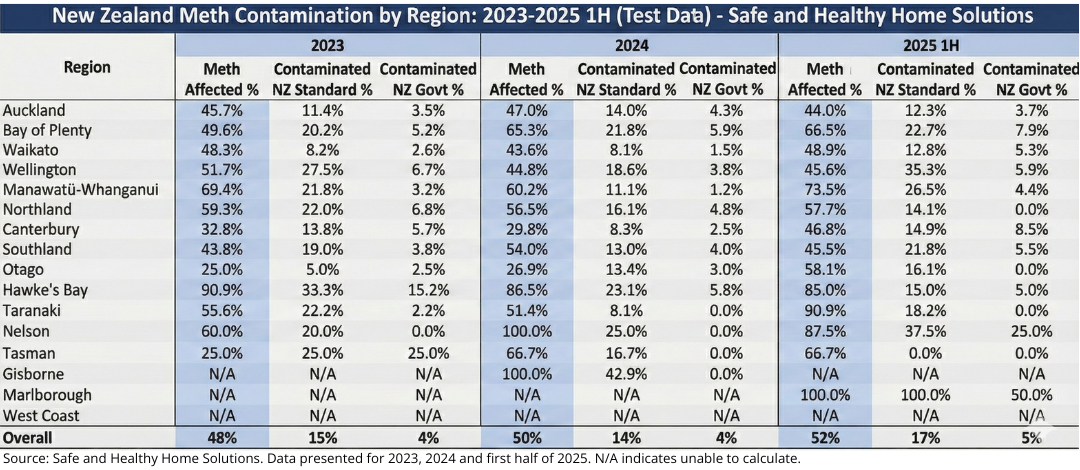
Auckland, home to around 40% of the population and where wastewater stats show the largest quantity of meth is used, and awareness of the risk this presents to property is highest, consistently accounts for close to half of all testing activity nationally. Yet its meth affected percentage sits in the mid-40% range across all three years, broadly aligned with the national average (SHHS, 2023–2025).
This matters because high testing volume tends to stabilise percentages by including the results of routine screening, not just suspicion-based testing. In regions where screening is embedded into due diligence, portfolio management, or standardised processes, results are more likely to reflect background contamination levels rather than only higher-risk cases.
By contrast, regions with a smaller share of total testing often record much higher meth affected percentages, frequently exceeding 60–70%. This does not necessarily indicate higher meth use in those regions overall. New Zealand’s wastewater-based drug monitoring data — reported as methamphetamine consumption per 1,000 people per day — shows that per-capita use is often comparable across regions, even where total volumes differ due to population size (New Zealand Police, 2024; New Zealand Police, 2025).
The more likely explanation reflected in SHHS testing data is a greater proportion of results arising from suspicion-based screening. In lower-testing regions, properties are often screened only where there is a known history that raises concerns due to behavioural issues or uncertainty during a transaction. This targeted approach naturally produces a higher proportion of positive results (SHHS, 2023–2025).
Government guidance on suspicion-based testing suggests that police involvement is the trigger for testing (Gluckman, 2018). In practice, most screening decisions occur independently of enforcement. Only very rarely does testing on suspicion involve police intervention.
Notably, some areas with lower testing coverage — including Hawke’s Bay, East Cape/Gisborne, and Rotorua — are also regions where meth-related harm has been well documented in public health reporting (New Zealand Police, 2024; New Zealand Police, 2025). This disconnect suggests that lower testing activity does not equate to lower risk. Indeed, delayed or avoided screening increases the likelihood that contamination remains undetected. This, in turn, increases the likelihood that when testing finally does take place, even government reference levels will be exceeded.
If testing happens after a property has been purchased, then the new owner will have paid market price for something that comes with free risk and liability. Cleaning this up will be done out of post-tax income. If it had been identified at the time of purchase, the problems could have been fixed through insurance claims and/or capital gain, and the correct market value would have been paid.
Understanding Regional Risk Profiles: Housing, Testing, and Detection Bias
Some regions record meth affected percentages well above the national average, but the drivers behind those percentages are not uniform. SHHS data indicate that elevated contamination generally falls into two broad regional risk profiles: housing- and testing-driven risk, and use-driven risk (SHHS, 2023–2025).
Regions such as Manawatū-Whanganui (affected rates approaching 70–75%), Hawke’s Bay (consistently above 85%), and Bay of Plenty (trending upward into the mid-60% range) are best understood through the lens of housing stock and testing behaviour. These regions share several structural characteristics:
- Higher proportions of rental and social housing, with frequent tenancy turnover
- Older housing stock, with materials that readily retain contamination
- Less routine, portfolio-wide screening between tenancies
- Greater reliance on reactive or suspicion-based testing
In these settings, meth affected percentages are influenced largely by who is being tested and when, rather than necessarily reflecting higher meth use across the wider population (SHHS, 2023–2025).
Northland presents a different — and particularly important — profile.
While some suspicion-based testing occurs, a substantial proportion of SHHS testing in Northland is routine and due diligence-driven, yet meth affected percentages remain consistently high. This aligns closely with independent wastewater monitoring, which shows Northland recording the highest per-capita methamphetamine consumption in the country (New Zealand Police, 2024; New Zealand Police, 2025).
Crucially, wastewater data indicate that while meth use approximately doubled nationally over a comparable period, Northland experienced an increase of around four times (ESR, 2024). Public reporting has also highlighted active gang-driven distribution and targeted market expansion in the region, helping to explain why contamination appears more frequently and more persistently across the housing stock.
Even within a policy environment where consequences for use have been reduced, these increases have still been observed. From a housing-risk perspective, Northland provides a clear example of how increased use translates directly into increased environmental exposure and may act as a leading indicator of broader trends if similar conditions emerge elsewhere.
NZ Standard Exceedance: Where Risk Concentrates
While meth affected percentages show how widespread contamination is, NZ Standard exceedance highlights where health-based risk escalates.
SHHS data shows that some regions with moderate meth affected rates still record elevated NZ Standard exceedance relative to the national average. Wellington is a clear example. While meth affected rates sit in the mid-40% range, the proportion of properties exceeding the NZ Standard has increased in recent testing periods, reaching just under 40% of properties where meth is present (SHHS, 2023–2025).
For context, the average NZ Standard exceedance across all SHHS testing over the past three years is materially lower, meaning Wellington sits above the national baseline even though its overall affected rate is not unusually high.
This suggests that where contamination is present in these areas, it is more likely to exceed health-based thresholds. SHHS experience indicates this can reflect a combination of unmanaged meth-related behaviour, repeated occupancy exposure, and delayed detection across multiple tenancies.
In regions such as Wellington, where SHHS has historically observed lower levels of routine or portfolio-wide screening, contamination is more likely to be identified later in the contamination cycle, increasing the probability that exceedance thresholds are reached before detection.
These factors are relevant to all parties associated with a property. Landlords have obligations under the Residential Tenancies Act (New Zealand Government, 1986/2023), and delayed detection increases the likelihood that those obligations may be breached. At the same time, tenants face a higher risk of prolonged exposure when contamination is not identified early.
By comparison, some regions with very high meth affected percentages show lower NZ Standard exceedance, but this does not indicate lower underlying risk. SHHS experience suggests this pattern is most often associated with actively managed housing portfolios, where frequent screening and early intervention limit the progression of contamination to higher concentration thresholds.
Manawatū-Whanganui provides a clear example. A substantial proportion of SHHS activity in the region involves higher risk properties, where tenancies are actively managed to suppress meth related behaviour, testing is routinely undertaken between occupants, and tenancy durations are relatively short. In these settings, meth is detected frequently — reflecting the underlying behavioural risk — but contamination is more likely to be identified early, before concentrations escalate to NZ Standard exceedance levels.
Importantly, international research on third-hand meth exposure demonstrates that meth residues persist at low levels and remain biologically relevant over time, even in the absence of ongoing use (Wright et al., 2022). This means that early identification matters: once contamination is present, it does not simply dissipate, and delayed detection increases the likelihood of accumulation and prolonged exposure.
The lower NZ Standard exceedance observed in actively managed portfolios is therefore best explained not by reduced exposure or benign contamination, but by consistent testing, early detection, and proactive property management, which interrupts escalation across successive tenancies and limits cumulative exposure pathways.
Government Threshold Exceedance: Small Percentages, Serious Implications
When the Gluckman Meth Report was released in 2018, exceedance of the higher reference level (15 µg/100 cm²) was identified as very low — less than 1%, even across higher-risk housing portfolios (Gluckman, 2018). This contributed to a widespread perception that meth contamination posed minimal risk. This perception was reinforced when looked at through the new ‘lens’ offered up by the Gluckman Report and considered in the light of media reporting at the time, which made no effort to consider the significance of the limitations within that report and the statements made to support its findings.
Current SHHS data shows that possible Government guideline exceedance remains relatively consistent at around 4–5%, representing a meaningful increase from 2018 levels (SHHS, 2023–2025). These cases are not evenly distributed.
Certain regions — including parts of Bay of Plenty, Nelson, Marlborough, and Canterbury — show sporadic but significant Government exceedances, often coinciding with lower testing coverage, high affected percentages, and late discovery of contamination. Ministry of Health commentary following the Gluckman Review acknowledged that severe contamination often reflects activity that remained undetected for extended periods rather than immediate behaviour alone (Gluckman, 2018).
While contamination being identified in a test that is not related to the current tenancy will still be a factor for some properties, the reality of the evidence of greater levels of meth consumption as shown in wastewater statistics means it is more likely than ever that people will be exposed to meth affected properties.
Stability Over Time: The Most Overlooked Insight
Perhaps the most striking insight from three years of SHHS data is how little the percentages change:
- Meth affected rates remain close to half of all properties tested.
- NZ Standard potential exceedance consistently sits in the mid-teens.
- Government standard potential exceedance remains elevated compared with 2018.
This stability suggests meth contamination is now a structural housing issue, influenced by legacy tenancy cycles, housing age and materials, gaps in routine screening practices and a response by property owners and their advisers to recommendations made by government (SHHS, 2023–2025).
It also explains why policy changes alone have not eliminated risk — undetected contamination does not resolve itself. In fact, the behaviour that leads to contamination continues unabated, and meth residues accumulate. Therefore, it is only a matter of time before the contamination exceeds government reference levels.
The reality is that government policy has enabled meth related behaviour and increased the likelihood of meth related problems occurring. These problems include contamination of property.
Assumptions that Meth Presents No Risk Continue to Fail People Who Rely on Them
SHHS data reinforces a reality supported by peer-reviewed research: meth contamination is often invisible, frequently originates from previous occupants, and exists across all housing types and regions (Wright et al., 2022).
Regions with newer builds, strong compliance frameworks, or lower perceived risk still show meaningful meth affected and exceedance percentages.
The problems we help people work through are more complex and challenging to resolve. Too often, it is because experience-backed indicators of risk have been ignored or dismissed or go unrecognised because people lack the knowledge necessary to spot them. The effect is that perceptions of meth risk are maintained, rather than engaged with in a way that allows the reality of the risk presented by meth related behaviour to be understood.
What the Data Suggests Going Forward
When three years of SHHS testing data are viewed alongside long-term testing experience and independent wastewater monitoring, several practical conclusions emerge (SHHS, 2023–2025; New Zealand Police, 2024; New Zealand Police, 2025):
- Systematic screening produces more reliable risk profiles than reactive testing
Regions where meth screening is embedded as a routine part of due diligence show more stable and predictable contamination patterns. In contrast, reliance on suspicion-based testing tends to inflate observed positive test rates by concentrating testing on higher-risk properties. - Higher testing coverage reduces uncertainty and strengthens compliance outcomes
Increased testing volume does not increase risk — it improves visibility. Broader screening lowers uncertainty across the housing stock, supports consistent application of standards, and reduces the likelihood of late-stage discovery. It also provides owners and their agents with tools to actively discourage meth related behaviour and attract quality tenants. - Legacy contamination persists but no longer fully explains current patterns on its own
More than a decade of meth testing has already identified a significant portion of historical contamination, with thousands of properties having legacy contamination addressed through decontamination work. The continued stability of percentages where property is affected by meth or reference levels exceeded indicates that while legacy residue remains relevant, it cannot fully account for present-day results. - Wastewater monitoring points to current behaviour as a key driver of new contamination
Independent wastewater data, reported on a per-capita basis, shows increasing methamphetamine consumption in recent years. When viewed alongside SHHS testing results, this suggests that current meth-related behaviour is now a primary contributor to new contamination entering the housing stock. - Percentage-based analysis provides clearer insight than isolated cases or headlines
Looking at trends and proportions over time reveals consistent national patterns that anecdotal reporting often misses. Percentages allow risk to be assessed objectively, without overstating isolated events or underestimating widespread exposure.
Final Thought: Percentages with context inform
Three years of SHHS meth testing data show that contamination in New Zealand homes is common, persistent, and unevenly detected where screening is limited to suspicion alone. It also demonstrates that active risk management — informed by evidence rather than assumption — is essential if exposure is to be reduced.
The solution is not fear, assumption, or denial. It is evidence, context, informed decision-making and active communication and risk management on the part of property investors, buyers and their agents – property managers or real estate salespeople, as well as the accountants, lawyers and bankers who provide professional advice.
That is exactly what percentage-based data — viewed alongside wastewater insights and regional mapping — provides.
Supporting References
Safe & Healthy Home Solutions. (2023–2025). National methamphetamine screening data: Percentage-based regional analysis [Unpublished internal dataset]. Safe & Healthy Home Solutions, New Zealand.
New Zealand Police. (2024). National drugs in wastewater testing programme: 2024 annual overview. New Zealand Government.
https://www.police.govt.nz/about-us/publication/national-drugs-wastewater-testing-programme-2024-annual-overview
New Zealand Police. (2025). National drugs in wastewater testing programme: Quarter 1, 2025. New Zealand Government.
https://www.police.govt.nz/about-us/publication/national-drugs-wastewater-testing-programme-quarter-1-2025
Wright, J., Walker, G. S., & Fitzgerald, R. L. (2022). Third-hand exposure to methamphetamine in residential settings: Case studies of exposure pathways and health implications. Toxics, 10(9), 482.
https://pubmed.ncbi.nlm.nih.gov/32825457/
Gluckman, P. (2018). Methamphetamine contamination in residential properties. Office of the Prime Minister’s Chief Science Advisor.
https://www.dpmc.govt.nz/sites/default/files/2021-10/pmcsa-Methamphetamine-contamination-in-residential-properties.pdf